
Knee arthritishas a new enemy
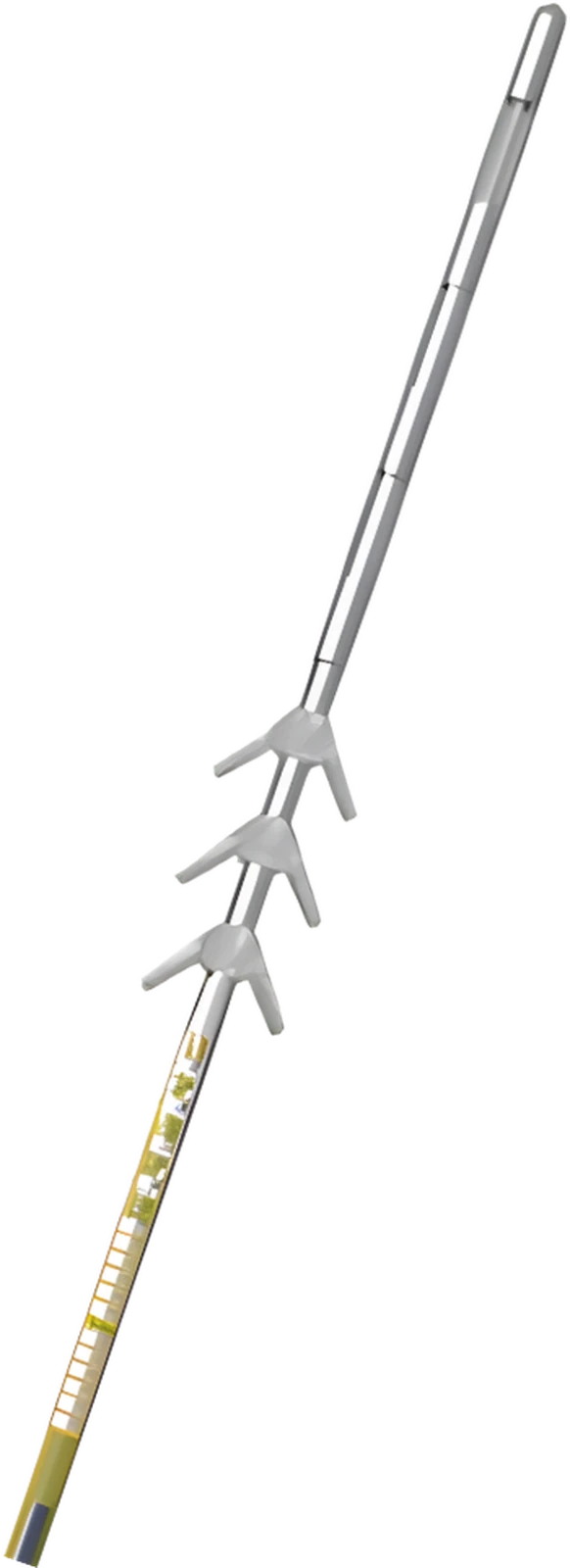
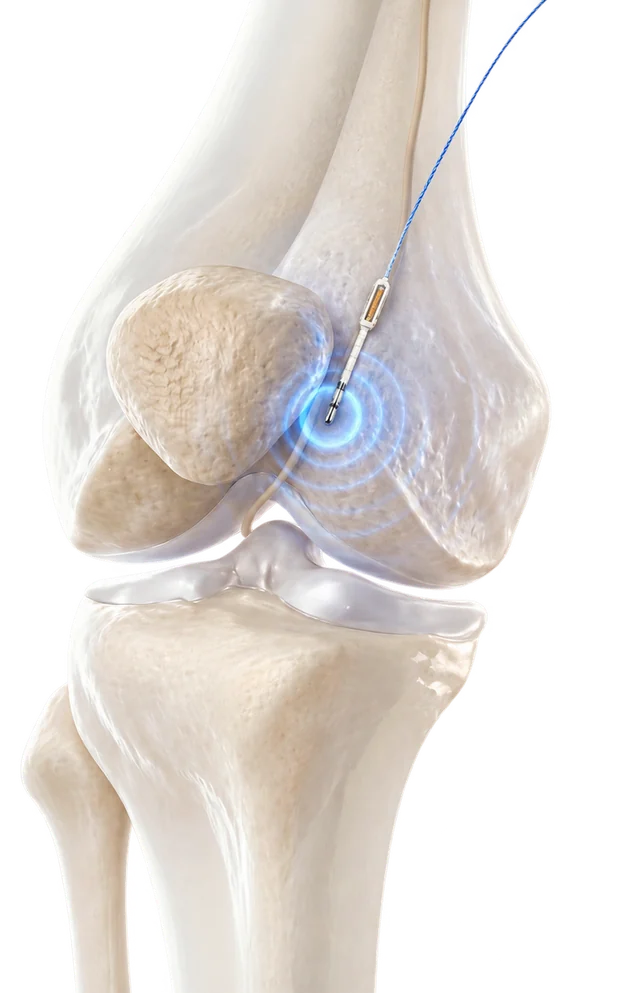
A thin electrode, placed near the nerve. Nothing is replaced, and no bone is cut.
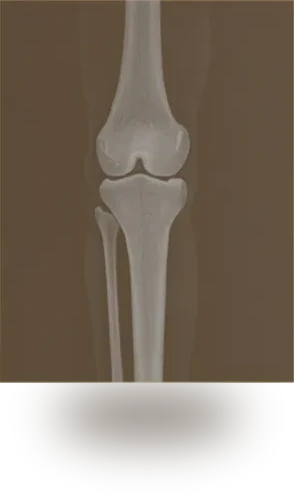
Check my kneeWhy the X-ray doesn't explain it
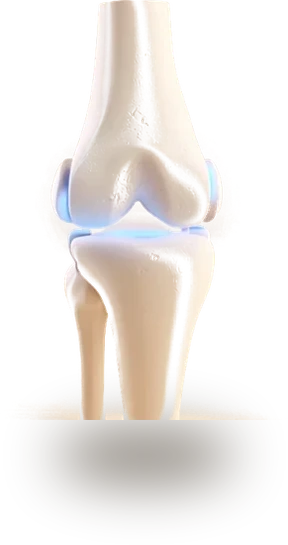
The joint wears.Then the nerve learns the pain.
Cartilage wear starts it. But after months of constant signalling, the nerves carrying that signal become overactive on their own — and stay that way even when imaging looks unchanged. Peripheral nerve stimulation is aimed at that signal. A thin lead is placed near the nerve. No joint is removed and no bone hardware goes in.
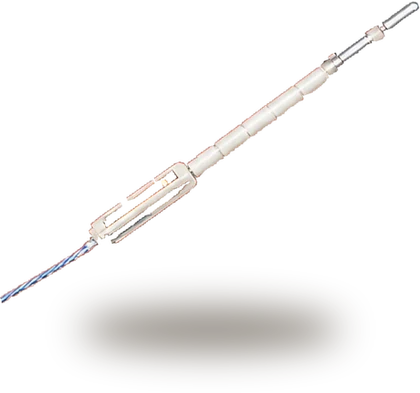
What is actuallyplaced
How the lead is placed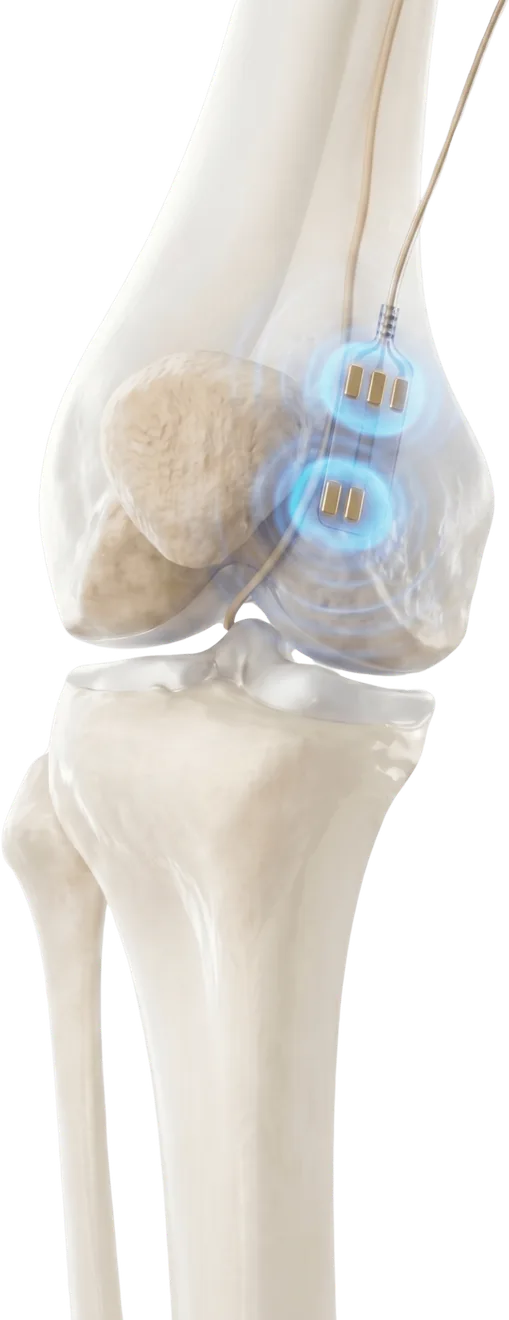
- A thin lead, positioned near the nerve carrying the pain
- No bone cut, and no part of the joint removed
Nothing is removed.It can come out again.
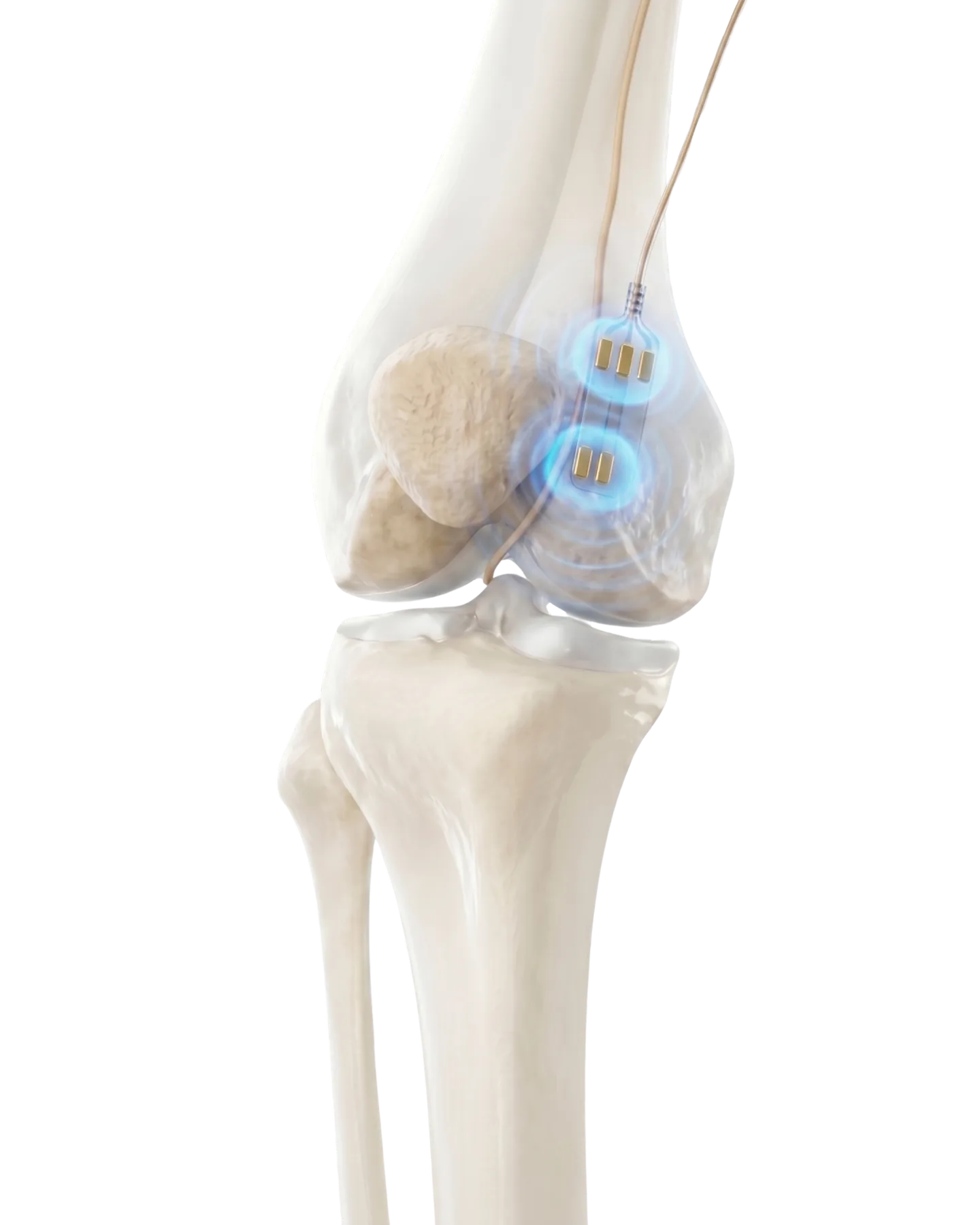
If the therapy is ever no longer wanted, the components can be removed by a physician.
Minimally invasive · Reversible · Outpatient
What actually happens
Nothing is decided on the first visit.
You’re evaluated
A specialist reviews your imaging and your pain history to see whether the pain you have is the kind nerve stimulation is used for. No procedure happens at this visit.
- No procedure at this visit
The nerve is identified
The specific nerves carrying your knee pain are located and targeted. That precision is what separates nerve stimulation from a general pain treatment.
- Nerve-specific
The therapy is placed
A thin lead is positioned near that nerve, as an outpatient procedure. No bone is cut and no part of the joint is removed.
- Outpatient
- No bone cut
You adjust it, and you can stop
You adjust the level of stimulation yourself day to day. If it is ever no longer wanted, the components can be removed by a physician.
- You set the level
- Removable by a physician

Who decides
What happens at each step is decided by the office you see, not by ARC. Ask them what their pathway involves before you agree to anything.
Start here
Which one of these is you?
Whichever you pick becomes the first answer of the assessment, and the rest follow from it.
Three questions in all, about a minute. It books nothing.
Educational only. ARC is not a healthcare provider and this is not a diagnosis.
Who arrives here
People arrive here with the date already booked, looking for what sits one rung below it.
Replacement isn’t the first step. It’s the last one.
Three rungs, in order. Most people are shown the third one first.
Where nerve stimulation sits
Preserving changes nothing about the joint. A replacement changes the joint itself. Nerve stimulation sits between the two, nearer the preserving end: it is a procedure, but no bone is cut and no part of the joint is removed.
ARC is not a healthcare provider. It does not treat, schedule or bill, and does not own the practices listed on this site.
Read more
Which rung is right for a particular knee is decided by the physician who examines it. Nothing on this page is medical advice, and ARC has no part in that decision.
Questions people ask
Read first.Decide after.
- Most asked
Am I a candidate?
- Compare
How does this compare to a replacement?
- Step by step
What does the procedure involve?
- Straight answer
Who should NOT get this?
- Straight answer
What if it doesn’t work?
- The mechanism
Why doesn’t my pain match my X-ray?
- Cost
What do Medicare and private plans cover?
- After
What does recovery look like?
Educational only. ARC Joint is not a healthcare provider, and nothing here is a diagnosis.
Read more
Library articles are written for people considering peripheral nerve stimulation and are reviewed for accuracy, but they describe the therapy in general. Whether it is appropriate for you is a decision only a physician who has examined you can make.
Who provides the care
Independent specialists. One simpler path forward.
ARC connects you with independent Arizona practices. Care is provided by the practice you see — ARC is not a healthcare provider and does not treat, schedule or bill.
Every office, and the specialty at each
Orthopedic Surgeon
Gilbert
Valley Bone and Joint
The specialty that would perform the replacement. An orthopedic surgeon evaluating you for nerve stimulation is evaluating an alternative to their own procedure.
Google rating 4.9 out of 5 from 355 reviewsOrthopedic Surgeon
Scottsdale
Valley Bone and Joint
The specialty that would perform the replacement. An orthopedic surgeon evaluating you for nerve stimulation is evaluating an alternative to their own procedure.
Google rating 4.9 out of 5 from 357 reviewsOrthopedic Surgeon
Casa Grande
Advanced Orthopaedics and Sports Medicine, P.C.
The specialty that would perform the replacement. An orthopedic surgeon evaluating you for nerve stimulation is evaluating an alternative to their own procedure.
Orthopedic Surgeon
Chandler
Advanced Orthopaedics and Sports Medicine, P.C.
The specialty that would perform the replacement. An orthopedic surgeon evaluating you for nerve stimulation is evaluating an alternative to their own procedure.
Neurosurgeon
Peoria
True Precision Medical
Trained on the nervous system rather than the joint — the specialty that treats the nerve carrying the pain rather than the cartilage that started it.
Google rating 4.9 out of 5 from 415 reviewsNeurosurgeon
Phoenix
True Precision Medical
Trained on the nervous system rather than the joint — the specialty that treats the nerve carrying the pain rather than the cartilage that started it.
Google rating 4.9 out of 5 from 411 reviews
Each practice is independently owned. ARC does not employ these physicians.
Read more
The ratings are Google's, read from each practice's own public listing, and they describe the practice as a whole — not this procedure, and not any one physician. Two locations of one practice can share a single listing, so the same rating may appear on both.

ARC does not treat, schedule or bill.
It publishes what the options are and, if you ask it to, passes your answers to an independent Arizona practice near you.
Ask the location and your plan what is covered. ARC does not bill and cannot promise what a plan will pay.
How coverage for this gets decided →
The guide
The questions to ask before you agree to a knee replacement
8 pages, written from ARC’s library: what the ladder below surgery actually looks like, who nerve stimulation is not for, and fifteen questions to take into the room with you.
What is in it
- What you are actually deciding
- Whether this applies to you
- Who it is not for
- Fifteen questions for your appointment
8 pages, 31 KB. No email, no form. It opens in a new tab and you can save or print it.
Or find out in about a minute whether this is even worth reading about.
ARC Joint is not a healthcare provider and do not give medical advice. Care is delivered by independent Arizona physician practices that are not owned by ARC. Nothing on this page is a diagnosis or a promise of a result — individual outcomes vary, and whether nerve stimulation is appropriate for you is a decision only a physician who has examined you can make.
Read more
The assessment on this site is educational and is not a diagnostic tool. ARC does not bill patients and does not take payment. Privacy Policy · Terms